KR Game Studios

Making Games on a Shoestring Budget!
Making Games on a Shoestring Budget!
by Kayne Ruse (Ratstail91)
It’s been a few weeks since my last post here, so lets discuss something related to Toy - not the langauge itself, but rather how I’m using it in practice. Because yes, I am actually using it.
I’ve added a simple function to Toy’s standard library, simply called rand(), which is implemented in C like this:
static void std_rand(Toy_VM* vm, Toy_FunctionNative* self) {
	//quick and dirty RNG seed
	if (self->meta1 == 0) {
		self->meta1 = 21795;
	}

	self->meta1 = self->meta1 * 1664525 + 1013904223;

	Toy_pushStack(&vm->stack, TOY_VALUE_FROM_INTEGER(self->meta1));
}
I’ll almost certainly add another function like srand() to set the seed manually, but for now this is fine. If you’re familiar with random number generators (because who isn’t?), you’ll recognize those magic numbers as part of a “Linear Congruential Generator” which, to put into simple terms, means I googled for the simplest RNG algorithm available for the time being1.
Having something available is the important part, which lets me do this:
fn rng() {
	return abs(rand()) % 4 + 4;
}
Which can in turn be used to select a random floor tile for this test room:
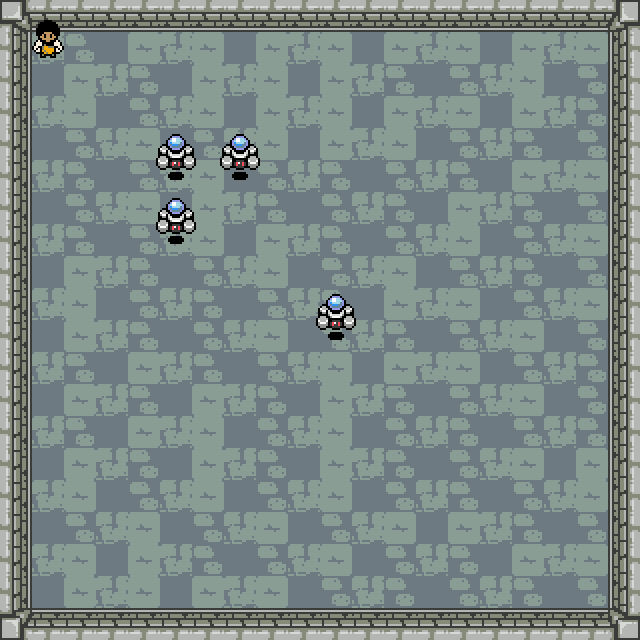
That floor ain't right.
Clearly, something’s wrong here. I have four floor tiles to choose from (at indexes 4, 5, 6 and 7, which is why there’s a + 4 in the above code), but somehow the algoritm I chose for rand() creates an oddly regular pattern when used like this (it can also return a negative value from the signed integer meta1, which is fixed with abs() - forgot to mention that).
I’m pretty sure this has something to do with multiples of four vs primes vs god knows what, but rather than spending a week relearning the intricacies of the Mersenne Twister, I decided to tweak the code to this:
fn rng() {
	return abs(rand()) % 3 + 4;
}
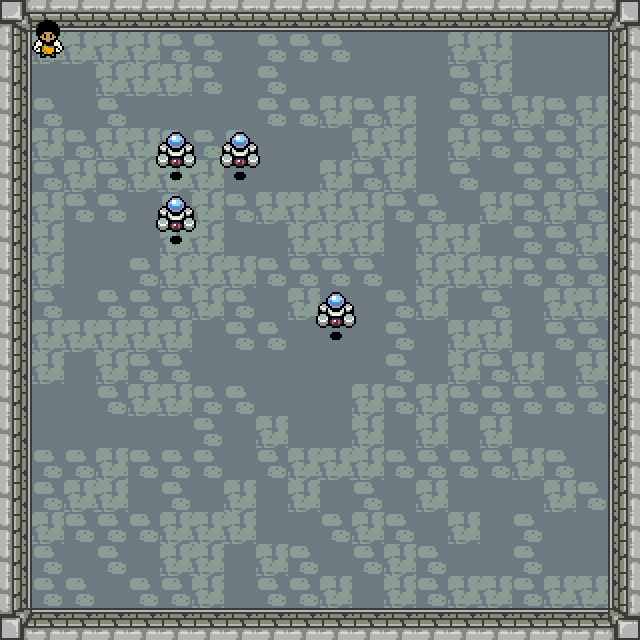
Something is missing.
This gives a passable result, but also cuts out one of the tiles, resulting in a slightly dull appearance.
Then, I got an idea: I know that I need to use a number other than some power of two, so why not five? This would mean a non-floor tile would normally be drawn, giving a glitched appearance, but what if I swapped those tiles for tile 0?
Behold, the reason I wrote this article:
fn rng() {
	return abs(rand()) % 5 % 4 + 4;
}
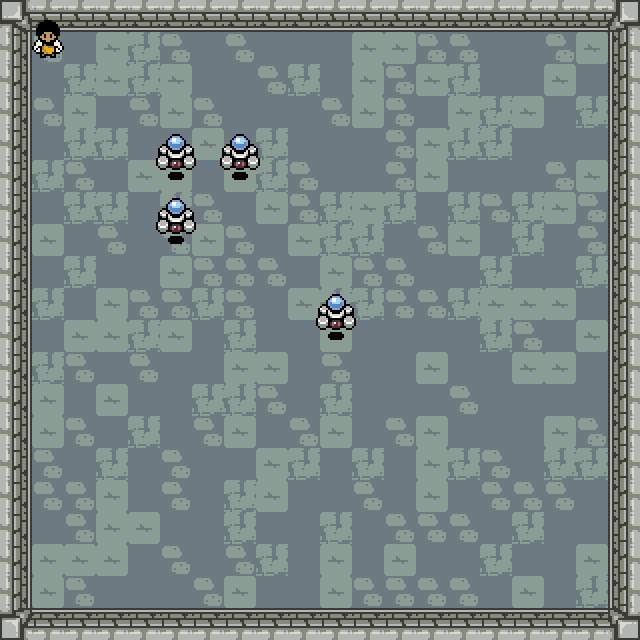
OK, that looks cool.
This also gives the nice side-effect of making the “blank” tile twice as common as the others, thus breaking up the floor’s overall texture. I can do a lot more with this pattern, but I’ll leave it here for now.
What do you think?
When I’m not running out of random jokes for this section, I can usually be found on Bluesky or Discord. If you’d like to show your support, I also have a Patreon, and I’d love a Coffee via Ko-fi.
I might’ve found it on wikipedia? I honestly can’t remember. ↩